Laying the Foundation and the Explosion: The Evolution of Telecom Architecture (1G - 4G)

Technological progress frequently originates in the collision between inquiries into fundamental physical laws and iterative engineering practice. If we strip away the surface-level digital abundance of modern society, what underpins it all is a century-spanning evolution of telecommunications architecture.
Physics Breakthroughs and Hardware Miniaturization
The prologue of this history began with a stroke of pure theoretical romance. In 1865, Scottish physicist James Clerk Maxwell published the elegant set of equations that predicted the existence of electromagnetic waves, demonstrating mathematically that invisible waves could propagate through empty space at the speed of light without requiring a physical medium. In 1887, Heinrich Hertz used an electrical spark-discharge apparatus in his laboratory to generate and detect radio waves for the first time, turning abstract theory into observable reality.
However, transforming sparks in a laboratory into transformative commercial infrastructure required hardware miniaturization. Early wireless telegraphy relied on crude coherers—tubes of loose metal filings that detected signals but required mechanical tapping after every transmission to reset. The throughput was excruciatingly low.
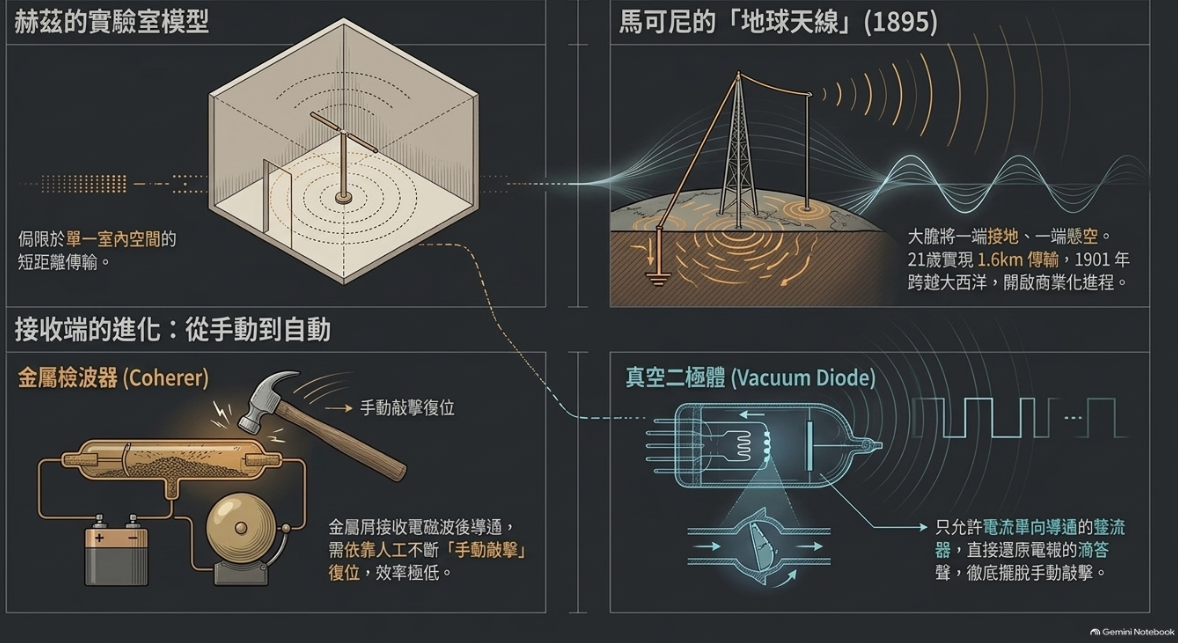
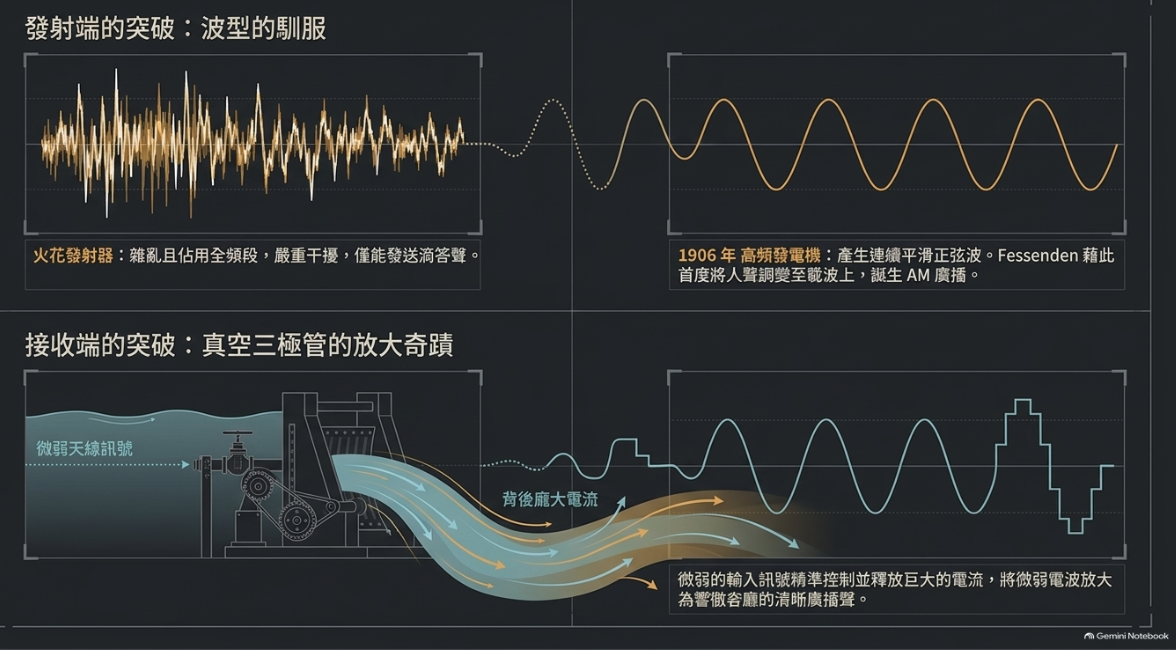
It was not until the invention of the vacuum diode (which could rectify telegraph signals) and the vacuum triode (which could dramatically amplify received electrical signals) that signal-processing bottlenecks were genuinely broken. These vacuum tube breakthroughs meant transmitters no longer required massive, power-hungry dynamos. Wireless equipment shrank radically, unlocking the commercialization of long-range radio telegraphy.
Battling Noise and Scaling System Capacity
As signals traversed open air, radio engineers engaged in a protracted war against noise and interference.
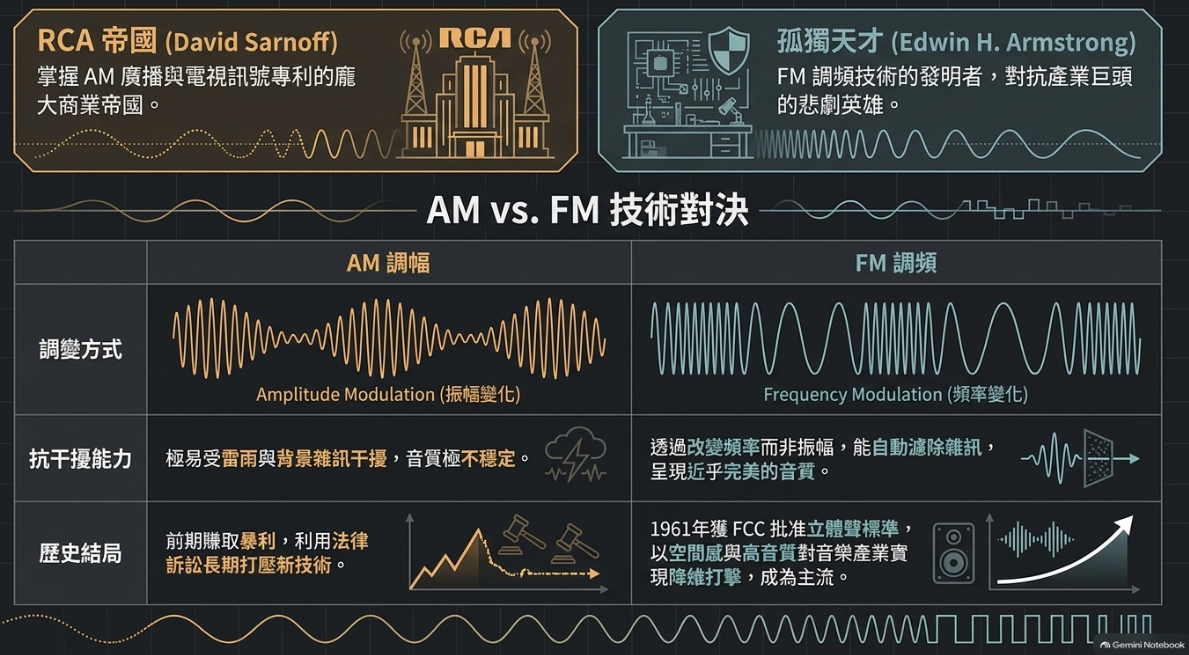
Early Amplitude Modulation (AM) was versatile—capable of transmitting voice and early television signals—yet it was notoriously susceptible to atmospheric noise, lightning, and industrial static. The subsequent invention of Frequency Modulation (FM), which encoded information by varying the frequency rather than the amplitude of the carrier wave, cleverly filtered out amplitude-based interference at the physical layer, delivering near-flawless high-fidelity audio.
When communications evolved from one-way broadcasts to private two-way conversations, the central architectural challenge shifted to system capacity. To prevent multiple simultaneous conversations from interfering, engineers introduced cellular network architecture and spatial frequency reuse via base stations.
Across multiplexing access technologies, mobile telephony underwent several profound paradigm shifts:
- 1G (FDMA - Frequency Division Multiple Access): Operating entirely on analog signals, individual users were allocated dedicated physical frequency channels for the duration of a call. Total system capacity was hard-bounded by the number of discrete radio channels available.
- 2G (TDMA / GSM - Time Division Multiple Access): Ushering in digital telecommunications, voice was quantized into binary bits. By carving out discrete time slots within the same frequency channel, multiple conversations took turns transmitting during natural speech pauses, dramatically improving spectral efficiency.
- 3G (CDMA - Code Division Multiple Access): Championed by Qualcomm, CDMA revolutionized spectral density. CDMA can be visualized as a crowded ballroom where everyone speaks simultaneously, yet every pair of speakers communicates in a unique, mathematically orthogonal "language (code)." Receivers easily decode their designated conversation while perceiving all other speech merely as low-level background noise. This architecture pushed throughput capacity to unprecedented heights.
4G: The Perfect Explosion Point for the Mobile Era
With the arrival of modern smartphones, human appetite for bandwidth outgrew simple voice and text, pivoting into exponential video and multimedia streaming. The architectural ceiling of 3G was reached almost overnight.
In 2008, the 4G LTE specification was finalized—a clean-slate architecture built from the ground up purely for packet-switched data transmission. 4G introduced OFDMA (Orthogonal Frequency Division Multiple Access) alongside MIMO (Multiple-Input Multiple-Output) antenna arrays. By squeezing every ounce of spectral efficiency from allocated frequency bands, 4G achieved massive peak throughput while driving network latency down to imperceptible levels.
Reflecting on this lineage, early telecommunications development was a classic example of "demand chasing technological breakthroughs." The frictionless YouTube 4K streaming and on-demand ride-hailing services we take for granted today were only made possible because 4G LTE broke through physical bottlenecks, perfectly catching humanity's explosive hunger for visual, real-time data.
The foundation of telecommunications infrastructure is an ongoing engineering epic of shattering physical limits and continuously reinventing resource allocation. And after 4G conquered human visual consumption, the next frontier—5G, 6G, and the Internet of Things—ventures into the complex trade-offs of millimeter waves and global coverage.
Comments
Loading comments…
Leave a Comment