The FDE Title Will Fade, but the Core Capabilities Won't
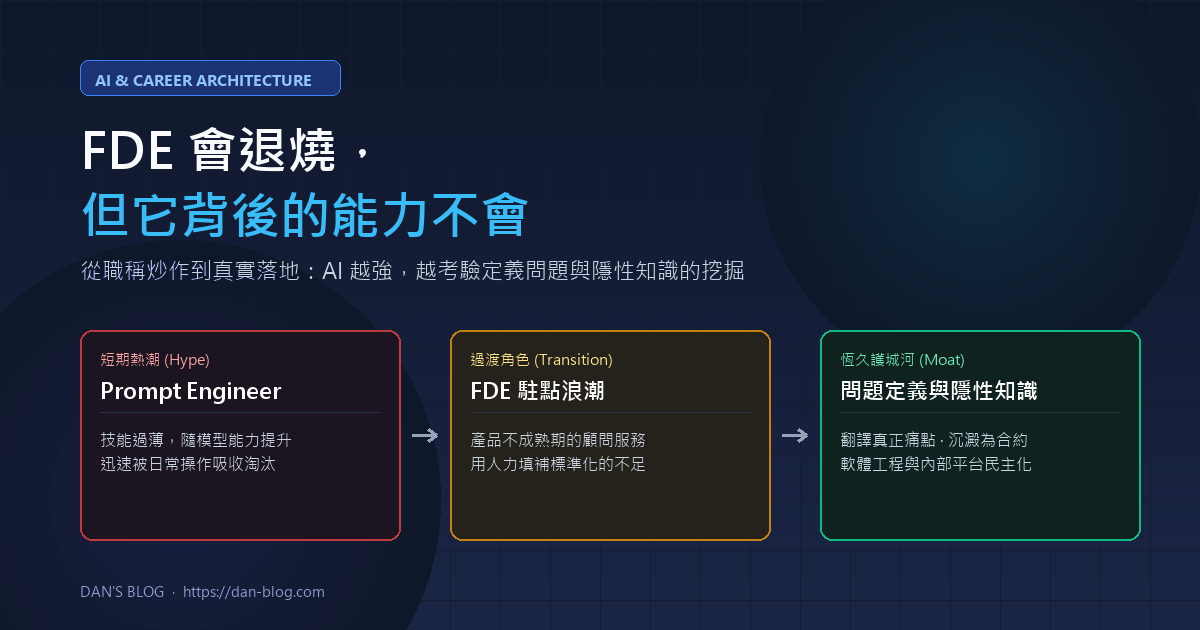
When generative AI first exploded, the hottest job title in town was "Prompt Engineer." Fast forward two or three years, and that term has virtually vanished from serious discourse. In its place stands a new buzzword: FDE, or Forward Deployed Engineer. According to data from Indeed cited by Business Insider, FDE job postings in April 2026 surged roughly sevenfold compared to a year prior. India's IT giant TCS even made waves by announcing plans to build an FDE workforce of up to 8,900 people.
Witnessing this sudden frenzy, my immediate gut reaction was: Is this just another manufactured hype cycle? But after reading through two in-depth special reports from Business Next and pondering the dynamics at play, I revised my perspective. My takeaway is this: the job title "FDE" will almost certainly fade, but the underlying capabilities it encompasses will not. In fact, their barrier to entry will only grow steeper.
Here is the chain of reasoning that led me there.
What Does an FDE Actually Do?
The FDE role traces its heritage back to Palantir. The core concept was straightforward: embed software engineers directly on-site with clients to facilitate solution integration and adoption. In recent years, AI trailblazers like OpenAI and Anthropic have aggressively replicated this playbook. In an interview with Business Next, Summit, the FDE Lead at Taiwan's Linker Vision, characterized the job essentially as a form of "translation": a client says they need A, but after digging beneath the surface, you realize their actual bottleneck is B. An FDE's primary task is to translate business ambiguity into the real problem space.
He offered an illustrative case study. Their team was tasked with building an AI-powered road pothole detection and automated dispatch system for Kaohsiung City. Purely from a technical standpoint, the computer vision model wasn't rocket science. Yet when deployed according to the explicit dispatch rules provided by the city government, the system was riddled with misrouted tasks. Only upon deeper probing did they discover that routing was historically decided by experienced civil servants with a single glance—relying on an intricate lattice of institutional intuition that had never once been written down. The engineering team had no choice but to ship rapid prototypes, put them in front of the operators, and iteratively extract that tacit knowledge through continuous back-and-forth feedback.
As Summit succinctly put it: "Model capabilities are already more than strong enough. Where projects actually grind to a halt is deployment."
The Title Is Hype; the Underlying Demand Is Real
The evidence that FDE is partly market hype is readily apparent even within the report itself. When Summit joined the company in 2025, his official title was "AI Solutions Architect." Later, marketing and client-facing trends prompted the rebranding to FDE—the daily work itself didn't change an inch. TCS's ambition to hire 8,900 FDEs is far more reasonably understood as rebranding existing enterprise consultants and delivery engineers, rather than eight thousand brand-new capabilities suddenly materializing in the labor market. The hardware industry has long had its own equivalent: Field Application Engineers (FAEs) in fabless IC design firms have spent decades "babysitting customer rollouts until they succeed."
However, just because a title is hyped doesn't mean the underlying demand is fictitious. Here, the comparison to "Prompt Engineer" only partially holds up.
Prompt Engineering evaporated because the skill layer was too shallow: as frontier models grew better at grasping intent and users learned basic instruction design, the skill was easily commoditized and absorbed. The core of an FDE, by contrast, revolves around defining messy problem spaces, unearthing hidden organizational constraints, understanding the frontier boundaries of AI capabilities, and taking ultimate ownership of outcomes. These are not things that disappear simply because models get smarter. Summit used a multiplication analogy: a stronger model increases the multiplier, but if the foundational problem is framed incorrectly from day one, an overpowered model will only amplify the mistake at scale.
Hence my revised conclusion: the buzzword will cool off, but the demand for these capabilities will endure—and as AI grows more capable, the barrier to entry will actually rise. When raw execution becomes dirt cheap, economic value concentrates overwhelmingly on knowing what needs to be executed in the first place.
Why Now? A Transitory Crutch for Immature Products
There is another thought-provoking perspective in the report: Summit noted that AI companies are pivoting to the FDE model because AI products are fundamentally distinct from traditional SaaS. SaaS features clear-cut specifications and standardized distribution; AI offerings, from the outset, demand heavy customization. In reality, they are sold far more like bespoke consulting engagements.
Looking at this from another angle, it amounts to an admission that FDEs are essentially plugging product deficits with brute human labor. If this is the primary driver, the FDE craze carries a strong cyclicality. Once AI platforms mature to the point of genuine out-of-the-box utility, the necessity for massive on-site deployment teams will contract back to a handful of ultra-high-value bespoke accounts. This dynamic explains the current acute spike in FDE demand—and why it is destined to normalize—far better than the simplistic narrative that "AI consolidates roles, so standards go up."
The Precedent: Walking the DevOps Path
A far more accurate historical parallel than Prompt Engineering is DevOps.
DevOps originated as a cultural philosophy bridging the gap between software development and infrastructure operations. Eventually, it morphed into a must-hire title, and companies scrambled to recruit dedicated DevOps Engineers. Over time, that fever subsided and branched into two distinct trajectories:
1. Platform Engineering: Dedicated internal teams building paved roads and self-service developer platforms.
2. Universal Competency: Fundamental DevOps awareness became baseline hygiene expected of any senior software engineer, rather than an isolated standalone role.
I anticipate the FDE role will trace a very similar trajectory: one portion will settle into the indispensable toolkit of senior engineers, solutions architects, and data leads; another portion will institutionalize into an organizational pattern—namely, Platform plus Enablement.
The Alternative: Democratizing the FDE
In my own day-to-day work within an enterprise AI infrastructure team, I manage the bottom of the stack: evaluating which AI tooling and shared agents can be safely adopted, and ensuring their stability and governance. Meanwhile, the actual authoring of domain-specific micro-tools is progressively shifting into the hands of end users themselves.
The underlying rationale is straightforward: tacit knowledge lives inside the user's head, not the FDE's.
The operational nuances that an external FDE has to painstakingly extract through multiple rounds of stakeholder interviews and prototyping can now be turned directly into functional code by domain experts wielding AI assistants. In this paradigm, a user-built prototype is itself the highest-fidelity requirements specification possible—far more precise than any PRD could ever hope to be.
If an organization piles the entire burden of surfacing tacit knowledge onto a dedicated FDE guild, it quickly recreates the classic Product Manager dilemma: developers complain that the PM lacks technical depth, while PMs complain that engineering misses business milestones. Every layer of translation hemorrhages contextual fidelity. Empowering business stakeholders to build directly eliminates that first layer of translation loss entirely.
This isn't an argument against the FDE mindset; it is an argument for democratizing it. Palantir's original blueprint also involved forward-deployed teams customizing solutions on a unified ontology, which the core platform team would subsequently distill into reusable components. The only evolutionary difference today is that the frontline layer is increasingly handed over to the end users themselves.
Integration: The Eternal Bottleneck
Yet, the PM dilemma doesn't vanish—it merely migrates downstream to the integration phase.
When end-user prototypes arrive at the platform engineering team for production hardening, friction inevitably re-emerges in a new shape: users feel their lightweight tools are being over-engineered or stalled, while platform engineers feel the prototype code is utterly unmaintainable spaghetti.
In practice, I have observed two different approaches, each suited to different stages of maturity:
- Working Software as the Anchor: Allow builders to hack together a rough tool first, using the tangible artifact as the anchor for requirements discovery. This shines in early exploratory phases where the problem statement is still fuzzy—just like the pothole case, you need something visible before latent edge cases surface.
- Interface Decoupling: Plan entry and exit points early with clear API boundaries, allowing teams to build independent utilities that can later be woven back into core systems. This works when the macro contours are already understood. The inherent risk, however, is premature standardization: fixing schemas too early risks cementing inputs and outputs before edge cases have revealed themselves. In the pothole example, the initial interface only tracked "pothole detected: yes/no"; only later did dispatch require pothole dimensions and road lane coordinates. Therefore, a v0 interface must always be treated as an explicit hypothesis subject to revision.
Beyond both strategies, the highest-leverage intervention I have found is requiring users to deliver test cases, not just raw code.
Tacit knowledge almost exclusively congregates in edge cases—nuances like "this specific scenario shouldn't count as an anomaly" or "this vendor requires specialized handling." If you only receive raw script files, those subtle rules are liable to evaporate silently during platform refactoring. If you receive a suite of concrete input-output pairings alongside the code, that tacit knowledge becomes locked into verifiable regression assertions. Interfaces define the shape of communication; test cases define the behavior. Combined, they constitute the only true contract between domain builders and platform stewards.
Furthermore, clear graduation criteria are essential: under what conditions does an internal utility graduate from user maintenance to platform ownership? Clear thresholds are mandatory—such as active daily users exceeding a target, decisions impacting compliance, scheduled batch executions, or the original author transitioning teams. Without explicit graduation gates, the platform team quickly turns into an organizational traffic jam.
For ephemeral, single-use, or micro utilities, everyone should be empowered to build freely. But remember: what prevents organizational fragmentation is not "everyone knowing how to vibe-code," but "everyone building upon a single, shared foundation"—shared access control, unified API governance, a centralized skill registry, and a searchable catalog of what colleagues have already built.
Incentives: The Chasm Beyond the Enthusiasts
Inspiring non-engineering domain users to pick up AI tools requires two complementary incentives: structural institutional backing from leadership (extrinsic motivation) and a visible platform for peer recognition (intrinsic motivation). The early champions will happily contribute; the pragmatists on the periphery will at least not push back.
This mirrors Everett Rogers' Diffusion of Innovations: enthusiastic innovators dive in headfirst, gradually spreading adoption outward. But as Geoffrey Moore famously warned in Crossing the Chasm, there is a treacherous gulf between early adopters and the pragmatic early majority that cannot be bridged on sheer momentum alone.
Enthusiasts build for the intellectual thrill and visibility; the pragmatic majority only care about practical friction: Will this reliably save me time? Has anyone in my department proven this works? Who is responsible when it breaks? Crossing that chasm demands copy-pasteable templates that work with two lines of tweaking, demonstrable success stories in their exact domain, and the ironclad guarantee that the underlying platform has dedicated support.
There is also a classic governance trap: if performance metrics incentivize "the raw number of tools created," you immediately trigger Goodhart's Law. The catalog will bloat with abandoned toys. Much healthier North Star metrics are active monthly adoption, cross-team reuse frequency, and audited hours saved.
Conclusion: Chase Capabilities, Not Titles
Returning to the opening question: Is FDE a mirage? Not entirely. It is a very real, high-leverage skillset wrapped in a trendy marketing label. The label will inevitably evolve; the capability will endure.
For individual engineers and knowledge workers: rather than sprinting to rebrand your resume with every new buzzword, invest in the core disciplines beneath the surface. Learn to distill chaotic requirements into crisp problem definitions, tease out unwritten organizational heuristics, understand the true operational boundaries of AI, and take relentless ownership of end-to-end outcomes.
For organizations: in the AI era, foundational software engineering rigor has become more critical than ever, not less. AI has driven the marginal cost of creating a working demo down to near zero, but it has not reduced the cost of maintaining it three years from now by a single penny.
Projects fail in two ways: building the wrong thing, and building the thing wrong. The former is avoided through the art of problem definition; the latter is avoided through architectural discipline and engineering hygiene. Neglect either, and the only result will be fragile, disposable tools that collapse under their own weight.
Comments
Loading comments…
Leave a Comment